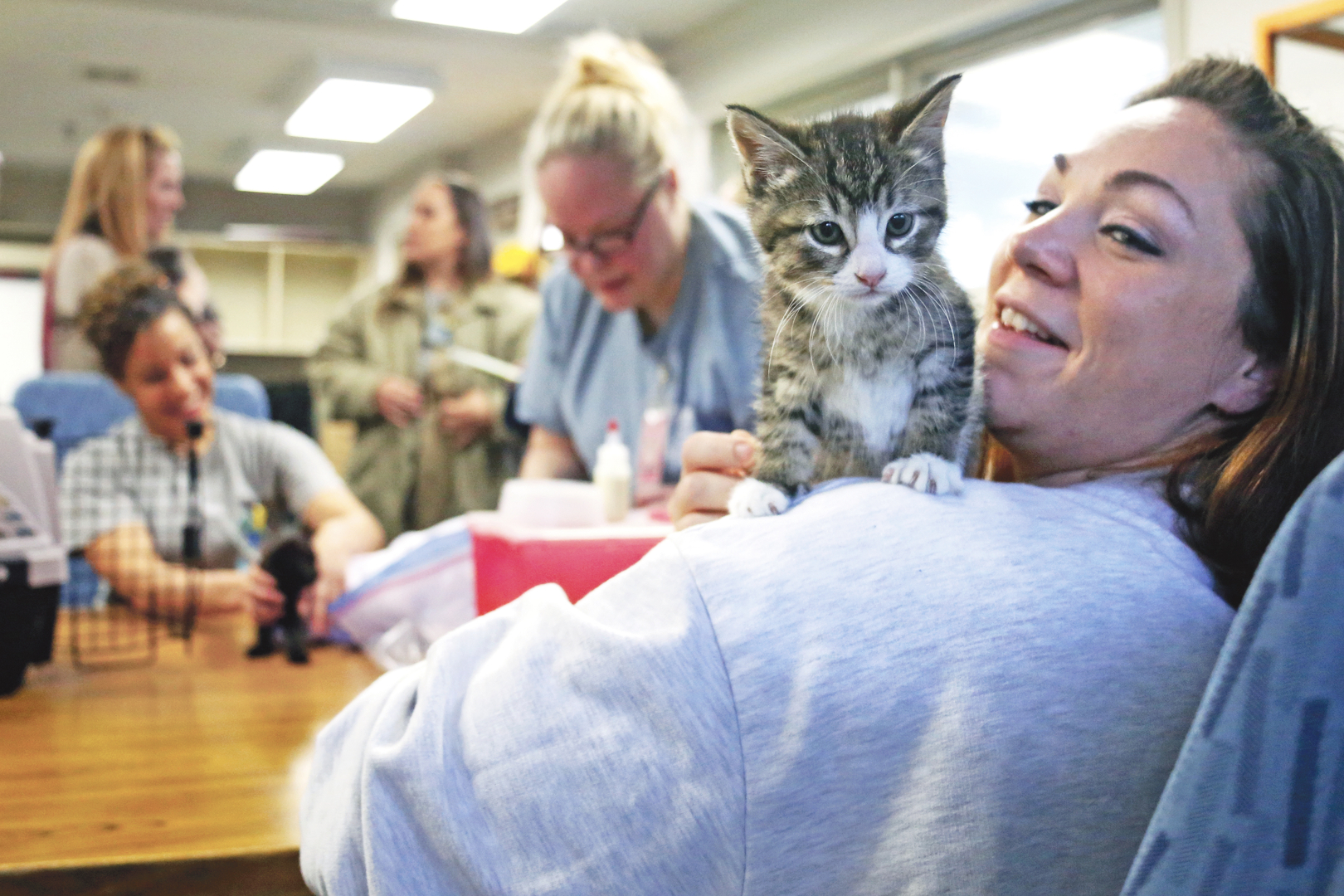
NICHOLE ALEXANDER SAT on the top bunk in her cell Nov. 11 at Mission Creek Correction Center for Women, reading a book by lamplight. The cinderblock walls were bare except for a small corkboard above each of the four bunk beds in the room. The cement floor was barren. For the most part, the room looked like a typical prison cell.
The one exception was a pair of fuzzy ears poking out of a blanket on the inmate’s lap.
Alexander peeled back part of the blanket as a cat lifted his head out of the bundle.
“This is actually a really big step for him,” Alexander said. “He wouldn’t even come out of his cage when he first got here.”
The cat, named Patrick, took one look around the room before burrowing deeper into his blanket, until just a tuft of hair was visible.
“That’s his coping mechanism,” Alexander said with a laugh. “He’s overwhelmed now.”
Patrick is one of 12 cats who recently took up residence at the women’s prison near Belfair as part of a new program with Kitsap Humane Society.
The Pawsitive Prison Program aims to rehabilitate cats that need extra attention before they can be adopted. The program started Oct. 28, when the cats were introduced to their new home in one wing of the corrections facility.
Five cells, each with four offenders, house one or more cats. One cell houses seven — one mom and her six newborn kittens.
Angela Hosking, corrections unit officer and Pawsitive Prison Program coordinator, spent the past several months instating the program after corrections center superintendent Eleanor Vernell approached her with the idea.
The cats selected for the program are those who have been abused or don’t know how to interact with humans. The offenders give the animals constant one-on-one attention, which helps the cats become more sociable and adoptable.
“The amount of individualized care and attention they get is really amazing,” Hosking said. “It’s the kind of care they might not normally be able to get, and it really makes a world of difference.”
Caring for the animals — feeding, cleaning, grooming and socializing — is left up to the individual cells and offenders. The inmates even keep notebooks of information, documenting cats’ habits and medical records.
“For Patrick, it looks like, ‘Patrick lifted his head’ or ‘Patrick left his cage,’ ” Alexander said. “We figure when he’s adopted out, he’ll go through the same kind of assimilation process, so we can give these notes to the family so they’ll know what to expect.”
Patrick was at the Kitsap Humane Society for years before he was moved to the corrections center for the program. Families were not interested in adopting such a shy cat, Alexander said.
“In his adoption picture, it’s not even a picture of his face,” she said. “They couldn’t get him to lift his head.”
While the program benefits the cats, the Pawsitive Prison Program is a symbiotic relationship —offenders gain something from the project as well. Hosking said offenders are learning valuable skills, such as teamwork and dedication.
“It gets them thinking outside themselves,” she said. “They have something depending on them.”
The offenders are also able to accumulate volunteer hours, which they can put on college or job applications.
Hosking developed an application process for offenders who wanted to participate in the program, which asked information-seeking questions on past experience with animals and why the women wanted to join the program.
More than half of the program participants said they planned to seek a career in animal care, such as veterinary technician, and wanted the experience.
“They get to see stuff that most other people don’t get to experience,” Hosking said. “Those skills will be invaluable when they are released and want to start a new life or go to college.”
In addition to helping build skills, the cats help rehabilitate the offenders mentally.
“It’s just such a comfort to have him here,” Alexander said of Patrick. “We don’t get to touch or hug, so if you have a hard phone call or something, you can cuddle with the kitty instead.”
Hosking said that because the offenders are all women, the cats help fulfill the primal maternal instinct most of the inmates have while they’re serving time.
Before being accepted into the program, offenders underwent a screening process, to ensure they had no crimes against vulnerable people or animals, as well as no infractions during their time in prison.
After being accepted to the program, offenders went through pet handling and emergency care training courses.
Hosking said the corrections facility is hoping to keep the program long-term. When the current cats are ready to be adopted, those will move out, and more cats will be brought in.
Likewise, as inmates are released from the corrections facility, more will be accepted into the program.
Published in the Shelton-Mason County Journal newspaper; Shelton, WA; 2016
 Brianna Hackler